When your website stops reflecting who you've become
The School of Somatic Leadership for Women™
This blog series celebrates my clients — their stories, their evolution, and the meaningful work they're bringing into the world. Each post also offers a glimpse into our creative process together.
There's a particular feeling many of us know: you open your own website, the one that's supposed to represent you, and it doesn't feel like you anymore.
The words are technically still true. The photos are still fine. But somewhere between then and now, you changed. Your work deepened, your voice matured, your sense of what you're offering the world evolved. And the website just... stayed still.
That's exactly where Isabelle, founder of The School of Somatic Leadership for Women™, found herself. Her training/offerings had expanded/deepened. Her story had evolved. But her website hadn't caught up. And she felt it every time she looked at it.
She came to me with that exact feeling. A sense that her website was no longer speaking for her. Over the next several months, we worked closely and slowly together, letting the redesign unfold until the site finally felt like a reflection of who she'd become.
Below, Isabelle shares what that process was like, and what's next for her and the women she trains.
When did you know your website no longer reflected you and your work?
It’s a feeling that slowly grew over time.
My website was a few years old, and since its creation, my work and its heartland had evolved, my skills had deepened and my vision expanded … new offerings had emerged and old offerings had retired. I had added and subtracted to reflect these shifts, which had left the flow clunky, and the look and feel no longer aligned with the essence of my work.
What did you most want a new visitor to feel within the first few seconds of landing on the new site?
My work is all about guiding women gently back to the wisdom of their bodies, to return to wholeness, vibrancy, sovereignty, aliveness … to heal, grow, flourish and expand.
It weaves together somatics, women-centred care and kinship with the living world we belong to.
Its heartland is our felt-sense, so it was incredibly important to me that any visitor would arrive in this virtual home and feel like they were stepping into a sanctuary. A place where their whole body would subtly soften, perhaps exhale a little more deeply … A space where they would feel both - a sense of being compassionately held, and a sense of hope, possibility and renewal.
I also wanted the imagery to be nature-inspired and elicit the feeling of belonging to the natural world.
Was there a moment during the redesign where something clicked…where you saw a page or a piece of language and thought, “yes, that’s it”?
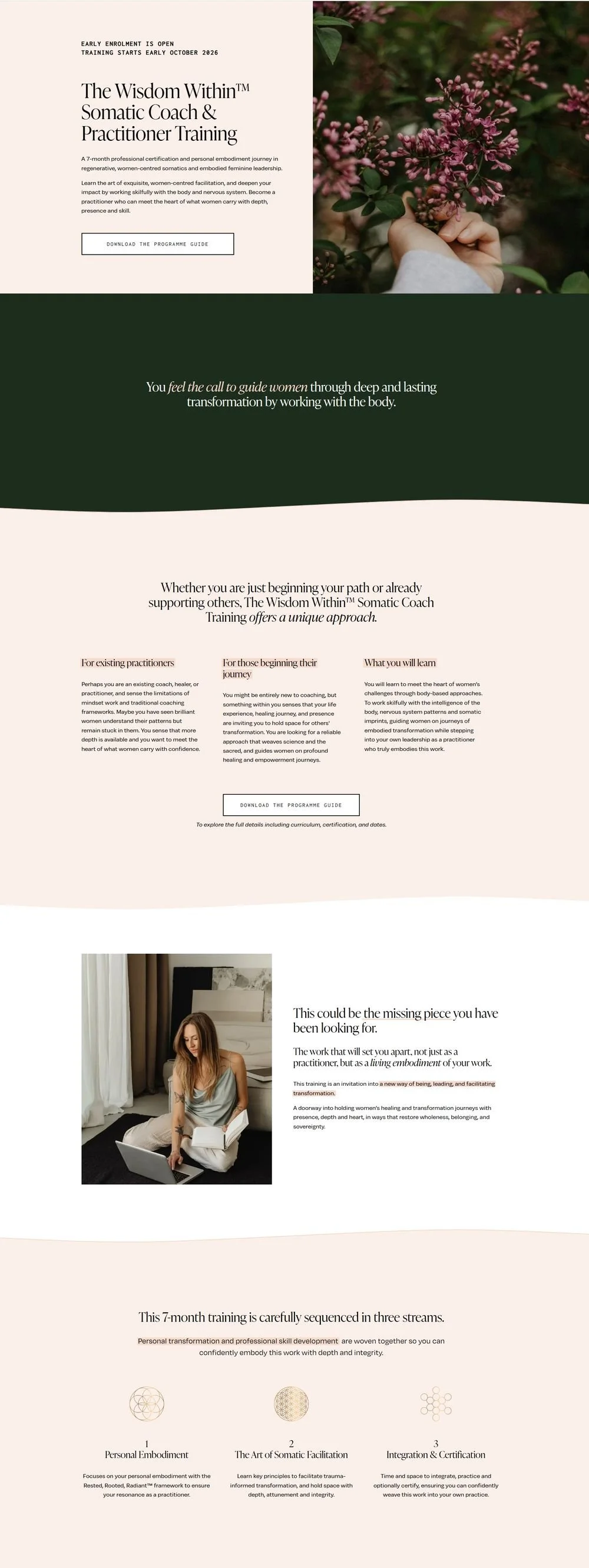
We deliberately staggered the process to let it breathe and find the website’s ‘felt-sense’ and voice. The first page we worked on was The Wisdom Within™ Somatic Practitioner Training.
As soon as I opened the page you had created and saw the imagery, the way the words were laid out, the darker tones you had woven in, the spacious flow and beauty - I felt like we had found the magic thread to weave through the rest of the website. You had beautifully captured what I hadn’t been able to fully express, and I could feel it immediately!
Your next round of The Wisdom Within™ training is coming up — can you tell us about it? Who is it for, and what will practitioners walk away with?
I’d love to! The Wisdom Within™ is a professional somatic practitioner certification and personal embodiment journey in women-centred, regenerative somatics.
At its heart, it’s an invitation into a different way of seeing and working with women.
So much of the helping world has taught us to look for what’s wrong, what needs fixing, resolving, processing. In The Wisdom Within™, we widen that lens. We learn to meet and honour what might be tender, while also noticing and cultivating more of what’s okay, what’s alive, nourishing and pleasurable even in small ways.
Of course, our graduates leave with a rich range of somatic skills and practices, and a deep understanding of how to work with the female nervous system and the body.
And yet, as vital as all of this is, one of the deepest transformations happens in the quality of their presence, the depth of their attunement, their capacity to stay grounded and walk alongside women in tender moments, their ability to listen beneath words and stories.
They learn to embody the very conditions that support healing, regeneration and flourishing.
And I love that we do this as a small circle of women journeying through the material together: experiencing it in our own bodies, reflecting, sharing and exploring it alongside each other.
How does the new site support you in welcoming people into that training?
It feels like the new site is inviting people into this path organically, offering women who are curious about this work the opportunity to explore it almost in a spiral shape. I imagine opening the door, inviting them to come in, look around, and stay for a cup of tea (and maybe some cake!) in the garden if they feel like lingering a little longer.
It’s a gentle pull to discover and deepen, which feels beautifully aligned with my work, philosophy and approach.
More about Isabelle Griffith
Isabelle Griffith is a Somatic Coach and Educator for women, the founder of The School of Somatic Leadership for Women™ andcreator of The Wisdom Within™ Somatic Practitioner Training.
She guides women to reconnect with their bodies, reclaim their inner wisdom, and lead from a place of rest, resonance, and self-trust. Through her deeply restorative and empowering approach, she supports women to move beyond burnout, people-pleasing, and self-doubt, towards a life that feels whole, alive, and aligned.
Her work is devoted to redefining feminine leadership as a regenerative force that ripples out into the world.